There is a question that almost every shopkeeper or professional has asked at least once: “Why does the business across the street have more customers than I do?” Often, the answer has nothing to do with the quality of the product or service. It has everything to do with local marketing, the set of strategies designed to ensure that people nearby choose you over the competition.
Local marketing (or proximity marketing) isn’t just a “lite” version of digital marketing; it’s a specific discipline. To do it right, you need to understand your territory and the people who live there, intercepting them at the right time with a consistent online and offline presence.
Analyzing the territory and local audience
Before launching an ad campaign or updating your Google profile, you must define your target audience and their specific needs. Think about the people in your neighborhood: what do they do for a living? What are their schedules? What problems are they trying to solve when they use their smartphones?
Start by analyzing local demographic data, observing competitors, and talking to your current customers. Your goal is to create a precise Local Buyer Persona, not a generic profile, but a real person with a local address and daily habits.
Geographic and behavioral segmentation
Not every resident in your area is a potential customer. Segmentation helps you narrow the field: distinguish between permanent residents, commuters who work nearby, and occasional visitors. This distinction completely changes your choices regarding communication channels, tone of voice, and posting times.
Google Business Profile and on-page local SEO
When someone searches for “bakery near me” or “dentist in [City],” you need to appear in the Google Local Pack, the map section with three featured results. The starting point is your Google Business Profile (formerly Google My Business). A complete, optimized profile is the most powerful lever you have for local visibility.
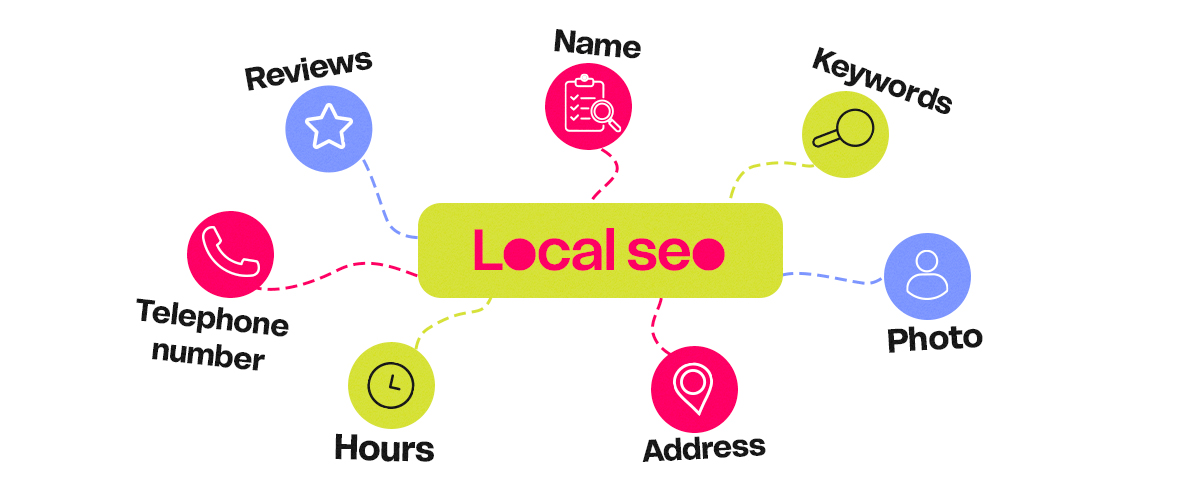
How to pptimize your profile
Optimization is straightforward: fill out every field, choose the right primary category, use relevant keywords in the description, and keep your hours updated. Reviews are critical: always respond to them, even negative ones, with a professional tone.
On your website, every page should include the city or neighborhood name in titles, meta descriptions, and body text. Additionally, use Schema.org LocalBusiness markup. This structured data tells Google exactly who you are and where you are, increasing your chances of appearing in “rich results.”
Targeted advertising for local audiences
Digital advertising has a massive advantage over traditional flyers: it allows you to target people in a specific area at a specific time. The main platforms are Google Ads and Meta Ads
Local Google and Meta Ads
With Google Ads, you can set a radius around your physical location (e.g., 1km or 5km). “Near me” campaigns work wonders for high-intent searches, such as “emergency plumber.” With Meta Ads, you can build audiences based on location combined with interests. Limited-time promotions (weekend discounts, local events) perform exceptionally well in Stories or Reels formats.
Local Events and Partnerships
Proximity marketing also lives offline. Organizing or participating in local events builds trust and brand recognition. Think of a clothing boutique collaborating with a nearby barber for an evening event: two audiences meet, and both brands expand their reach.
Measuring results: key KPIs
A common mistake in local marketing is “doing things” without understanding what works. You only need 3-4 key indicators:
-
Google Business Profile Insights: Views and requests for directions.
-
Store Visits: Tracked via specific coupon codes or promos.
-
Conversion Rate: How many local clicks turn into actual inquiries or sales.
-
Reviews: Number of new reviews and average rating per month.

Local marketing: showing up matters
Local marketing works when it is consistent. It’s not about a one-time update; it’s about a continuous presence that speaks to your neighbors. From territory analysis to geolocated ads, these pieces fit together to turn local satisfaction into business growth.
condividi